The display above is the plugin's own drawing code, running here in the page.
The first minute
| Do | What happens |
|---|---|
| Insert it and play the busiest bar | The dot on the curve is the signal, right now. Where it sits tells you whether the threshold is anywhere near the material. |
| Bring the threshold down until the dot crosses the knee | That is the moment compression starts. Below it nothing happens, whatever the ratio says. |
| Set the ratio by watching the curve, not the number | A gentle slope is gentle compression. The number is the same information, drawn worse. |
| Then set attack and release by ear | The reduction meter tells you how much; your ears tell you whether it breathes. |
Reading the screen
The curve maps input to output. A straight diagonal is no compression, the bend is where it starts, and the slope after the bend is the ratio. The dot is where your signal sits on that map right now.
| What you see | What it means |
|---|---|
| The diagonal | Input equals output. Anything on this line is untouched. |
| The bend | Threshold. Signal below it is not compressed. |
| The slope after the bend | Ratio. Flatter means more compression. |
| The rounding at the bend | Knee. A soft knee starts compressing before the threshold, gradually. |
| The moving dot | Your signal. If it never reaches the bend, nothing is happening. |
| The GR meter | How many decibels are being removed at this instant. |
The controls
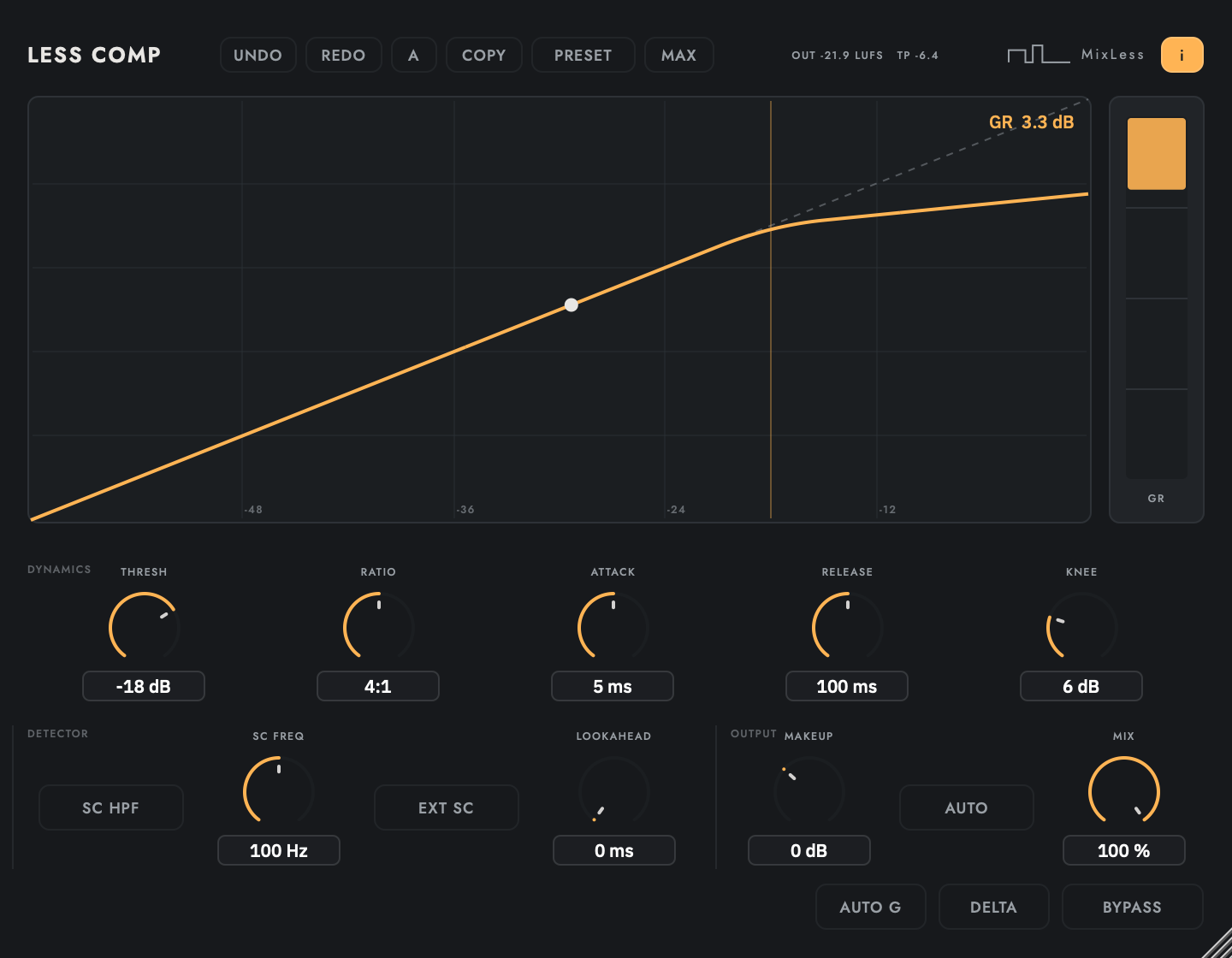
| Control | What it does |
|---|---|
| THRESHOLD | Where compression starts. |
| RATIO | How hard it compresses above the threshold. |
| ATTACK, RELEASE | How fast it grabs and lets go. Transients live here. |
| KNEE | How gradually the ratio arrives. |
| MAKEUP | Gain added after compression, to match levels again. |
| SIDECHAIN | Compress this channel from another one. The classic use is a bass ducking under a kick. |
| LOOKAHEAD | Delays the audio so the detector sees the transient coming. Costs 240 samples of latency at 5 ms. |
How to work with it
Set the threshold with the meter, the ratio with the curve, and the timing with your ears. In that order two of the three decisions are visible before you start arguing with yourself about the third.